

Across the UK charity sector the conversation is changing
For years, trustee boards focused primarily on funding, compliance and operational oversight. Those things still matter, but the environment charities are now operating in a far more complex, volatile and demanding environment.
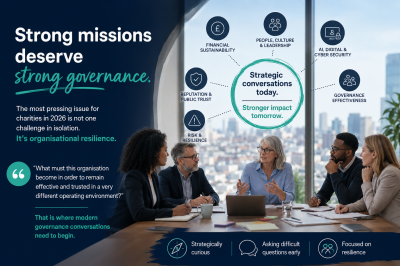
The most pressing issue facing many charity leaders in 2026 is organisational resilience.
Not simply “can we balance the budget?” but whether organisations can remain financially sustainable, trusted, digitally competent, well governed and critically mission-focused at the same time.
Leaders are trying to navigate rising demand for services alongside increasing costs and growing workforce and donor fatigue. At the same time, organisations are grappling with digital transformation, AI and cybersecurity risks, reputational pressures and greater public scrutiny. What is striking is that these are no longer isolated challenges. They are converging.
For trustees, this means governance discussions need to evolve too.
Boards should now be spending meaningful time discussing long-term financial sustainability and whether their current operating models are genuinely viable. They should be thinking carefully about organisational culture, staff wellbeing, leadership succession and whether expectations placed upon teams remain realistic. Increasingly, trustees also need to understand the implications of AI, data protection, cybersecurity and digital governance, rather than treating them as purely operational matters.
Alongside this sits the growing importance of reputation and public trust. Many charities are operating in an environment where public criticism, misinformation and political polarisation can rapidly affect confidence and stakeholder relationships. Governance structures themselves also need scrutiny, with boards asking whether they remain fit for purpose in a changing world.
In many organisations, the greatest risk is no longer lack of commitment or passion.
It is governance inertia.
The strongest boards I see are strategically curious, willing to ask difficult questions early, focused on resilience rather than optimism alone and able to create space for proper discussion instead of simply reviewing papers.
Perhaps the most important question trustees should now be asking is:
“What must this organisation become in order to remain effective and trusted in a very different operating environment?”
That is where modern governance conversations need to begin.